

Artesian Pumps
Artesian pumps (often referred to as deep-well or submersible pumps) are specialized mechanisms designed to bring high-pressure underground water from deep layers of the earth to the surface. They possess many unique features that set them apart from conventional water pumps.
Key Features of Artesian Pumps
-
Ability to operate at great depths: While conventional surface pumps can draw water from a maximum depth of 8–9 meters, artesian pumps can easily push water up from depths of tens or even hundreds of meters (e.g., 50–300 meters and more).
-
Submersible design: These pumps operate entirely underwater (at the bottom of the well) rather than outside of it. Because they work on the principle of pushing water from the bottom upward, they are much more efficient and eliminate air-priming issues.
-
Multistage system: High pressure is required to lift water vertically from great depths. For this reason, artesian pumps feature multiple impellers (stages) arranged in series. As the number of stages increases, the pump’s lifting height (pressure) capacity increases as well.
-
Ergonomic and cylindrical design: Since well casings are narrow, these pumps are engineered in a long, slim cylindrical shape. In the market, models with diameters of 3 inches (3″), 4 inches (4″), and 6 inches (6″) are the most common.
-
Water-cooling and silent operation: Since the pump is completely submerged, the surrounding water automatically cools the motor during operation. Furthermore, because it remains deep underwater, it does not generate noise like surface pumps and operates completely silently.
-
Corrosion and wear resistance: Because they constantly operate in aquatic environments and sandy-clay terrains, their bodies and internal components are manufactured from high-quality stainless steel, bronze, or specially hardened polymers.
K typed Console Pumps
Key Features of K-Type Pumps
-
Simple and reliable construction: Since it features only a single impeller, its internal structure is not complex. Disassembly, repair, and maintenance are remarkably easy. It is even possible to replace internal components without displacing the piping.
-
Inlet and outlet direction: Fluid enters the pump directly from the front (axially), gains velocity through centrifugal force, and exits upward at a 90-degree angle (vertically).
-
Fluid requirements: These pumps are primarily designed for pumping clean or slightly contaminated industrial water (with solid particle content not exceeding 0.1%). In standard models, the maximum water temperature can be up to 80–85°C.
-
Suction limit: Unlike artesian pumps, K-type pumps are installed on the surface. Because they are not self-priming, they can only draw water from a maximum depth of 5–7 meters, and the pump casing must be filled with water (primed) before startup.
-
Wide performance range: They are manufactured in a highly diverse range of sizes. From small garden plots to large industrial enterprises and municipal water mains, there is a model tailored to fit every pressure and flow requirement.


Multistage Sectional Centrifugal Pumps (CNS)
The abbreviation CNS (ЦНС) is derived from the Russian phrase “Центробежный Насос Секционный”, which translates to Centrifugal Sectional Pump (or multistage sectional pump). These pumps are among the most powerful industrial equipment used in fields requiring high pressure (high head fluid delivery).
Key Features of CNS Pumps
-
Ultra-high pressure (High head capacity): These pumps can effortlessly lift water or fluids over immense distances and heights, ranging from 100 to 800 meters and even higher.
-
Sectional (modular) construction: The pump casing is assembled from individual sections. The number of sections (impellers) can be increased or decreased depending on the specific application and required pressure. This modular setup also simplifies maintenance; if a component fails, only the damaged section needs to be replaced or serviced.
-
Axial force compensation (Hydraulic balancing disc): Since all impellers are arranged facing the same direction, a powerful axial thrust is generated along the shaft. To counteract this force and prevent premature shaft wear, CNS pumps are equipped with a specialized hydraulic balancing mechanism known as a hydraulic balancing disc (разгрузочный диск).
-
Horizontal installation: Unlike multistage artesian (submersible) pumps, industrial CNS pumps are installed on the surface in a horizontal position on a dedicated foundation and are driven by heavy-duty electric motors.
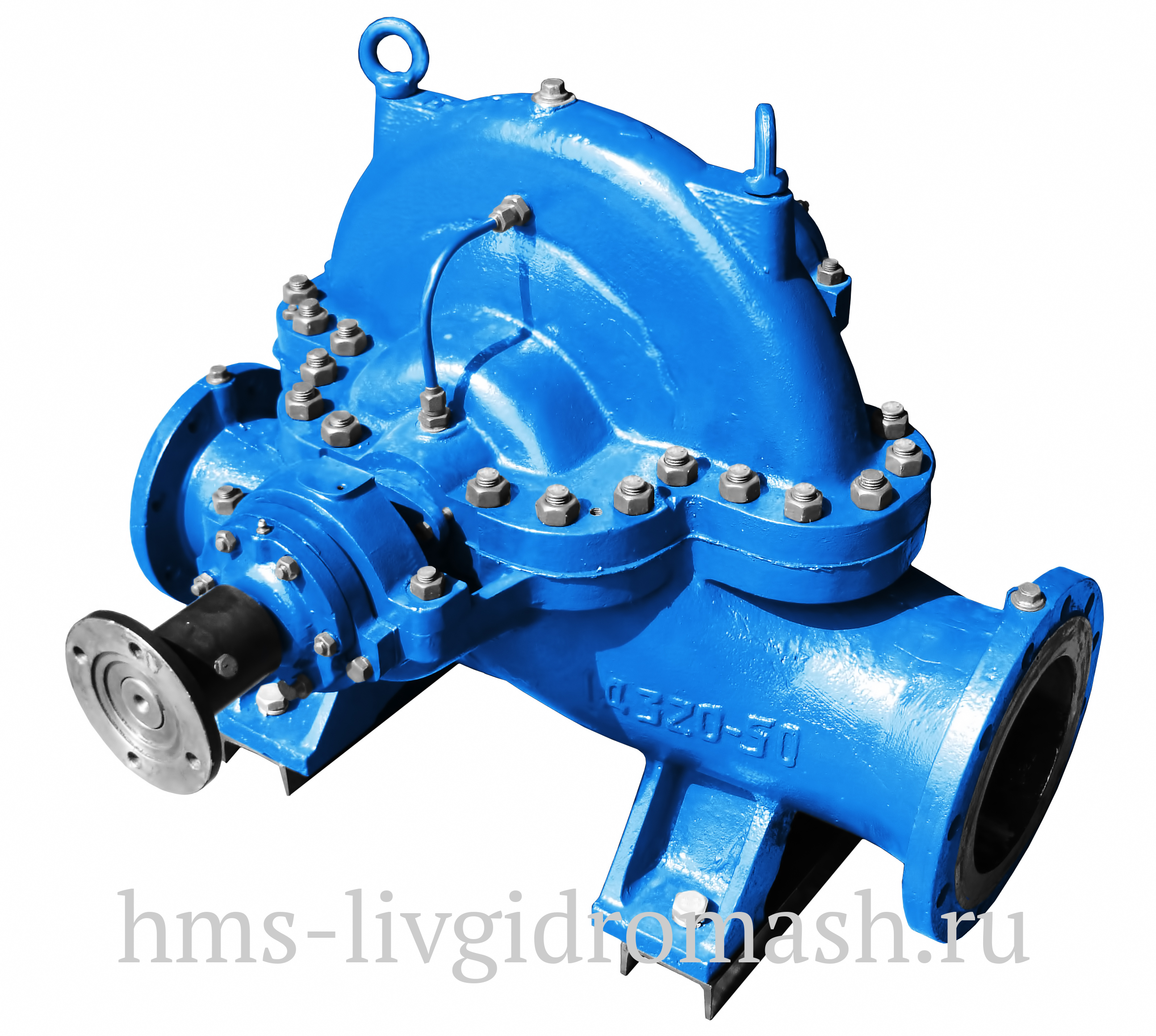
Double-ended D pumps (Д)
These pumps are massive horizontal industrial machines installed to transport huge volumes of water (for instance, supplying water to an entire city or a major industrial plant).
Key Features of “D” Type Pumps
(Note: In international engineering standards, these are widely known as horizontally split-case or double-suction centrifugal pumps)
-
Natural balance of axial forces: The most ingenious aspect of these pumps lies in their internal design. Because water enters the impeller from both the right and left sides with equal pressure, the axial (thrust) forces pushing the shaft sideways neutralize each other. Consequently, there is no need for complex balancing discs like those found in CNS pumps, and the bearings experience significantly less wear and tear.
-
Horizontally split-case design: The pump casing is divided along a horizontal line into two distinct parts—the upper and lower casing. This design makes maintenance incredibly straightforward. To service or replace internal components (such as the impeller, shaft, or mechanical seals), there is no need to move the electric motor or disconnect the suction and discharge piping. Simply removing the bolts on the upper casing is sufficient.
-
High cavitation resistance: Since the fluid enters the impeller through two separate suction channels, the intake velocity of the water drops. This effectively prevents cavitation—the formation and sudden collapse of vapor bubbles that can erode and destroy internal metal components. As a result, D-type pumps boast superior suction lift capabilities compared to other surface pumps.
-
High Efficiency Rating: Because hydraulic losses are kept to an absolute minimum, the efficiency of these pumps is exceptionally high (typically between 80% and 90%). In large-scale pumping stations, this high efficiency translates into substantial electrical energy savings over time.

Vertical Multistaged Pump Station
Vertical multistage pump stations (more commonly known as Smart Booster Systems in both industrial and domestic applications) represent one of the most advanced and efficient solutions in modern water supply. These stations consist of a combination of multiple multistage centrifugal pumps mounted vertically on a single metal chassis (frame) and integrated with an intelligent control unit.
Their primary purpose is to maintain a constant and stable water pressure within the network in facilities experiencing fluctuating water consumption (such as multi-story residential and commercial buildings).
Key Features of Vertical Pump Stations
-
Exceptional space savings (Compactness): The greatest visual and practical advantage of these stations is the vertical arrangement of the pumps. Compared to horizontal pump stations (such as CNS type) of equivalent power, vertical systems require 3 to 4 times less floor space. This makes them ideal for installation in cramped building basements or specialized modular containers.
-
Intelligent Variable Frequency Drive (VFD / Inverter) Control: Modern vertical stations are equipped with smart PLC panels and frequency inverters. The system continuously monitors the pressure within the pipelines. For instance, if only a few residents use water late at night, the pumps operate at a very low speed, utilizing minimal energy. When water demand spikes simultaneously in the morning, the pumps automatically ramp up their speed and bring backup pumps online as needed. This system architecture delivers energy savings of up to 40%.
-
Uninterrupted operation and redundancy: These stations typically feature 2, 3, 4, or more pumps operating in parallel. If one pump is shut down for routine maintenance or experiences a failure, the control system automatically redistributes the hydraulic load among the remaining operational pumps. Consequently, the facility is never left without water for even a single second.
-
Long lifespan and quiet operation: All hydraulic components of the pumps (casing, shafts, and impellers) are manufactured from high-grade stainless steel (AISI 304 or AISI 316). Thanks to the vertical alignment, the mechanical load on the shaft is distributed evenly, minimizing axial vibration and allowing the system to operate almost completely silently.
Drainage Pumps
Drainage pumps are specialized equipment designed to evacuate (drain) dirty, sandy, or muddy water from flooded areas, basements, wells, construction sites, and rainwater trenches. Unlike the previously mentioned industrial pumps, the primary advantage of drainage pumps is their ability to handle and pass solid particles (such as sand, small stones, and fibers) suspended in the water without clogging.
Key Features of Drainage Pumps
-
Solid handling capability: The impellers of these pumps feature a specialized design, such as a Vortex (vortex-flow) or an open-type configuration. Depending on the specific pump model, this design allows them to easily pass sand, silt, and small stones with diameters ranging from 5 mm up to 50 mm through the discharge lines.
-
Automatic float switch system: Almost all drainage pumps are equipped with a mechanical or electronic float switch. As the liquid level rises, the float lifts and automatically triggers the pump to start. Once the water is fully evacuated, the float drops and shuts the system down. This crucial mechanism prevents the motor from running dry and burning out.
-
Mobility and easy installation: These pumps are engineered to be lightweight and highly portable, coming equipped with a dedicated carrying handle. They can be lowered into the target area using a simple rope, connected to a flexible discharge hose, plugged into a power source, and put into operation immediately.
-
Motor cooling: When submersible drainage pumps operate underwater, the cold medium passing through the pump casing automatically cools the internal motor. Some advanced models feature a “cooling jacket,” which prevents the motor from overheating even if the pump is not entirely submerged in the liquid.


NK type oil pumps
NK-type pumps—known in industry and technical literature as Petroleum and Oil Cantilever Pumps (derived from the Russian: Насос Нефтяной Консольный)—are structurally very similar to the classic “K” type water pumps mentioned earlier. However, they are specifically engineered to transport completely different and highly aggressive media, such as petroleum, petroleum products, liquefied gases, lubricating oils, and high-temperature hydrocarbons.
Because the viscosity, flammability hazards, and operating temperatures of oils and fuels differ drastically from water, NK pumps are built with strict safety standards and distinct design features.
Key Features of NK-Type Oil Pumps
-
High explosion protection (Ex-proof): Since the pumped fluids (oil, gasoline, fuel oil) are highly flammable and explosive, the electric motors used in NK pump systems must be equipped with specialized explosion-proof enclosures. This completely prevents any potential internal electrical sparks from escaping into the surrounding environment.
-
Double sealing (Leak-proof) system: Fluid leakage in these pumps is not merely a resource waste, but a severe fire hazard. Therefore, instead of conventional gland packing, NK pumps utilize double mechanical seals (двойное торцовое уплотнение). A specialized neutral barrier fluid is circulated between these seals to provide continuous cooling and prevent toxic or flammable vapors from escaping into the atmosphere.
-
Extreme temperature resistance: While standard water pumps fail when handling hot fluids, NK pumps can seamlessly transport heavy oils and petroleum residues heated from 0°C up to +200°C—and even up to +400°C in specialized modifications, depending on the casing material and seal type.
-
Wear-resistant materials: The pump’s internal impellers and casing are manufactured from cast iron (SCh20), carbon steel (25L), or high-quality corrosion-resistant stainless steel (12Kh18N9TL) to match the specific chemical composition and abrasiveness of the petroleum product being pumped.